Common Assignment Writing Mistakes Students Must Avoid
Assignment writing is a critical component of academic success. While many students possess subject knowledge, they often lose marks due to avoidable writing, research, and formatting mistakes. Understanding these common errors and learning how to avoid them can significantly improve grades and academic confidence.
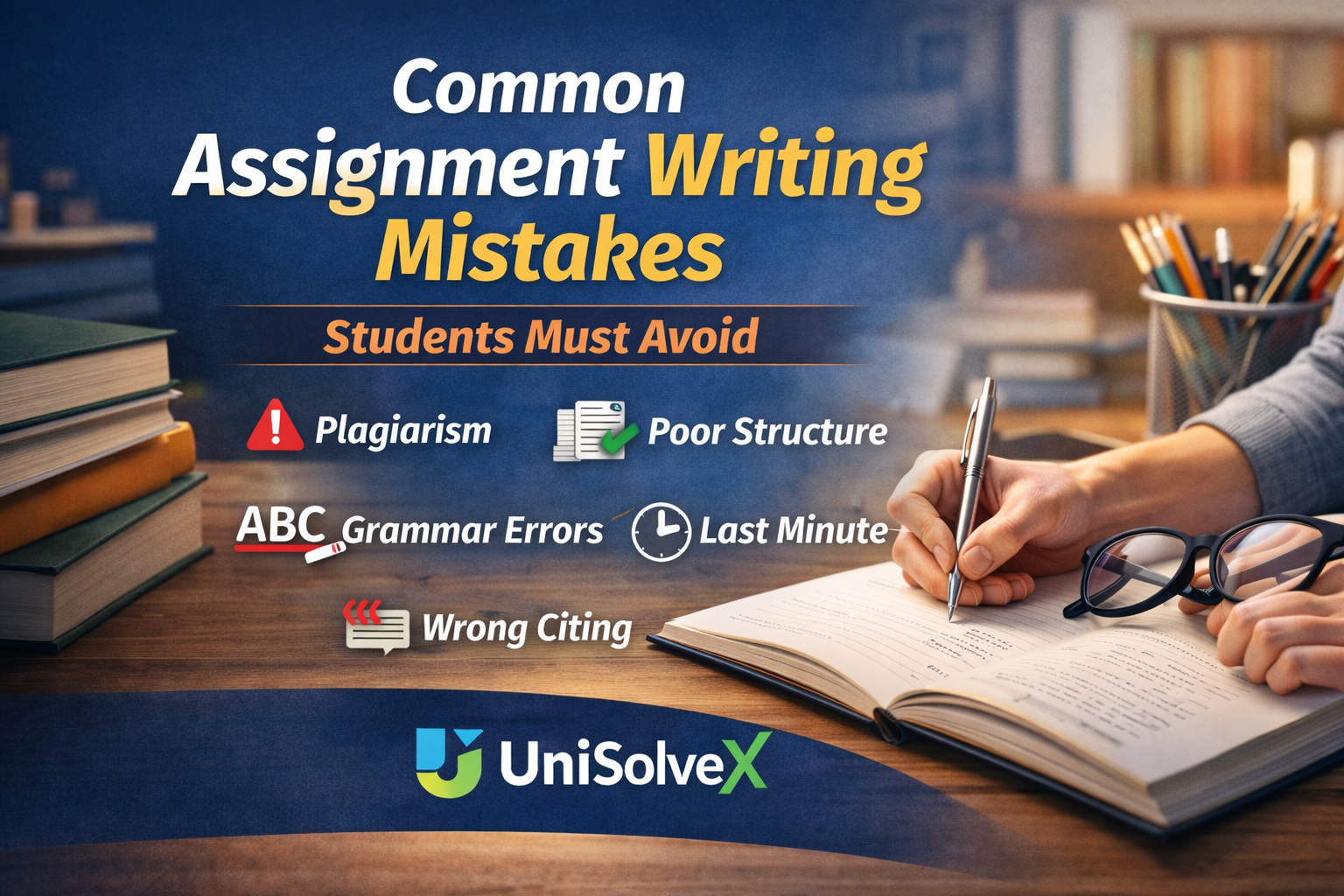
1. Not Understanding the Assignment Requirements
One of the most common mistakes students make is starting an assignment without carefully reading the instructions. Every assignment comes with specific requirements such as word count, formatting style, referencing guidelines, topic scope, and submission format. Ignoring these details can result in unnecessary mark deductions.
For example, if the question asks students to “analyze” a topic but they only “describe” it, they fail to meet the core requirement. Carefully reading the brief, identifying key instruction words, and clarifying doubts with the instructor can prevent major mistakes before writing even begins.
2. Lack of Proper Planning and Structure
Jumping straight into writing without planning often leads to disorganized ideas and weak argument flow. A well-structured assignment should have a clear introduction, logically arranged body paragraphs, and a strong conclusion. Without planning, students may repeat points or miss important arguments.
Creating a simple outline before writing helps organize thoughts and ensures smooth transitions between paragraphs. Planning saves time during editing and improves overall clarity.
3. Weak or Unclear Thesis Statement
The thesis statement acts as the backbone of an assignment. It defines the central argument and guides the direction of the entire paper. A vague thesis can confuse readers and weaken the impact of the content.
A strong thesis should directly answer the assignment question and clearly state the writer’s position. Every paragraph in the body should connect back to this main argument.
4. Poor Research and Use of Unreliable Sources
Academic assignments require credible and relevant sources. Many students rely heavily on random websites, blogs, or outdated statistics. This weakens the reliability of their work.
Instead, students should use peer-reviewed journals, academic books, official reports, and university library databases. Strong research adds depth, credibility, and authority to arguments.
5. Plagiarism and Improper Referencing
Plagiarism is one of the most serious academic offenses. It occurs when students copy information without giving proper credit. Even accidental plagiarism, such as missing citations or quotation marks, can lead to penalties.
To avoid plagiarism, students must paraphrase information in their own words, cite all sources correctly, and follow the required referencing style such as APA, MLA, or Harvard. Using plagiarism detection tools before submission can also help ensure originality.
6. Ignoring Formatting Guidelines
Presentation plays a significant role in academic grading. Common formatting mistakes include inconsistent fonts, incorrect margins, missing headings, and improper citation formatting.
Following institutional formatting guidelines strictly shows professionalism and attention to detail. A well-presented assignment leaves a strong impression on evaluators.
7. Weak Introduction and Conclusion
The introduction is the first impression of the assignment, while the conclusion is the final takeaway. Many students write introductions that are too general and conclusions that simply repeat earlier points.
A strong introduction should provide background context and clearly present the thesis statement. An effective conclusion should summarize key arguments and reinforce the central idea while leaving a thoughtful final insight.
8. Overcomplicated Language
Some students believe that using difficult vocabulary makes writing more academic. However, overly complex sentences can reduce clarity and make arguments harder to understand.
Academic writing should be clear, concise, and precise. Simplicity and clarity are more valuable than unnecessarily complicated language.
9. Lack of Critical Analysis
Assignments often require critical thinking rather than simple description. Merely summarizing information does not demonstrate deep understanding. Evaluators expect students to compare viewpoints, interpret evidence, and provide analysis.
Asking questions such as “Why is this important?” or “What are the implications?” can help develop stronger analytical arguments.
10. Grammar, Spelling, and Proofreading Errors
Even a well-researched assignment can lose marks due to grammatical errors and spelling mistakes. These errors reduce readability and make the work appear careless.
Proofreading multiple times, reading the assignment aloud, and using grammar-checking tools can significantly improve writing quality. Editing is just as important as drafting.
11. Poor Time Management
Procrastination often leads to rushed assignments with weak arguments and incomplete research. Starting early allows time for planning, writing, revising, and editing.
Breaking the task into stages—research, outlining, drafting, and revising—can help manage time effectively and reduce last-minute stress.
Conclusion
Avoiding common assignment writing mistakes can dramatically improve academic performance. Success in assignment writing depends on understanding requirements, conducting strong research, organizing ideas logically, and carefully proofreading before submission.
Academic writing is not just about completing a task; it is about demonstrating understanding, critical thinking, and effective communication. By identifying and correcting these common mistakes, students can build confidence, achieve higher grades, and develop skills that are valuable beyond the classroom. With preparation, clarity, and consistent effort, assignment writing becomes a manageable and rewarding process.
Need Help With Assignments or Projects?
Get expert academic help, plagiarism-free content, and on-time delivery with UniSolveX.
💬 Get Help on WhatsApp